Translate

martedì 15 aprile 2014

Alarm after Rome embryo mix-up

Woman carrying twins that are not genetically hers


(ANSA) - Rome, April 14 - Rome's Sandro Pertini Hospital was inundated with telephone calls Monday from worried couples seeking reassurances after reports that a woman was implanted with the wrong embryos at the facility and was carrying twins that are not her own. The Roman hospital has helped hundreds of people with assisted-fertility treatment, many of whom now fear that children they are expecting or that have been born to them may not be genetically theirs.

The Pertini Hospital is conducting a series of tests to verify the accuracy of DNA tests carried out by the parents who reported the embryo swap, "also to reassure the others", the hospital said. The lawyer of the couple that reported the mix-up also sent the documentation of the DNA exam to Roman public health authorities. The documentation will be analyzed while during the wait for the results of additional exams.

The woman has decided to take the pregnancy to term, her lawyer told Rome-based newspaper La Repubblica. "I had a moment of human rejection when I knew that they were not mine, or rather ours, that the embryos that I was carrying were of another woman, but then we decided that the pregnancy had to continue, our values are these," said the woman according to her lawyer, Michele Ambrosini. 

Archeologists uncover corridor in Florence Roman theatre dig

'Vomitorium' served 15,000 ancient theatre-goers


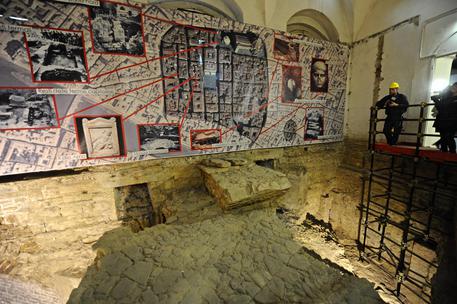
(ANSA) - Florence, April 14 - Archaeologists digging up the remains of an ancient Roman theatre discovered under the Palazzo Vecchio in Florence have found a "vomitorium" or corridor used by as many as 15,000 theatre goers in the first and second centuries A.D., city officials say.

The latest find at the site in the centre of the Tuscan capital includes the original painted stone pavements along which spectators used to walk from the outer circle of the theatre to the orchestra pit, which already had been excavated during previous digs. Also discovered were well shafts going as deep as more than 10 metres below the current surface of Florence, providing water and waste disposal for the theatre, as well as remains of the foundations of the walls used to build the Salone dei Cinquecento.

The Roman theatre was built originally for use by an audience of some 7,000 people but at the height of its popularity in the first and second centuries AD as many as 10,000-15,000 spectators are believed to have packed in to enjoy performances there, the archaeologists say. The remains of the theatre cover a vast portion of land under Palazzo Vecchio and Palazzo Gondi, with the cavea cells in which wild animals were confined facing the Piazza della Signoria and the 'scena' or stage along what is now the via dei Leoni.

The theatre was in use until the 5th century before being abandoned and eventually forgotten. Its remains were gradually brought to light in the 18th century when Florence was transformed into the first capital of a united Italy in 1865 and the city centre was systematically modernised. A new archeological investigation was carried out at the end of the 1990's with full-scale excavations taking place between 2004 and 2010. 

F1: Domenicali quits Ferrari, takes blame for poor form

'Put team first again', says Montezemolo


(ANSA) - Maranello, April 14 - Stefano Domenicali on Monday quit Ferrari after six years as Formula One team boss, saying he was taking the blame for the Italian glamour team's poor form over recent years. Domenicali, 48, resigned with immediate effect and was quickly replaced by Ferrari North America CEO Marco Mattiacci, the historic Italian racing team announced. Mattiacci's appointment was also effective immediately, Ferrari said.

Ferrari Chairman Luca Cordero di Montezemolo issued a statement thanking Domenicali "not only for his loyal contribution and commitment, but for his great sense of responsibility that knew how to put the interests of Ferrari before his own". The chairman went on to thank Domenicali for his 23 years with Ferrari. "I also want to wish Mattiacci the best, a prized manager who has accepted this challenge enthusiastically," said the former head of Fiat.

Domenicali, 48, struggled to keep the Scuderia competitive after winning a constructors' title - some would say fortuitously - in his first year with Ferrari in 2008, a year after the Scuderia's last drivers' triumph with Kimi Raikkonen under the legendary Jean Todt in 2007. 

Govt rejects bank 'blackmail' on tax hike

Delrio says banks have denied credit to families


(ANSA) - Rome, April 14 - Italian Premier Matteo Renzi's government will not accept "blackmail" by banks threatening to choke off credit to families and firms if faced with a tax hike, Cabinet Undersecretary Graziano Delrio said Monday. "The banks say that because of this taxation they will cut credit to families and firms? We will not stand for it, this is blackmail that we don't accept," Delrio said in an interview with Rai's Porta a Porta programme.

"The banks received 1,000 billion (euros) from the BCE and transferred almost nothing of that to families," he added. The banks had complained about a tax hike planned by Renzi to get the cash needed for a signature tax cut on low earners, saying it would deepen Italy's credit crunch. Renzi recently announced he was doubling the levy on banks' surplus deposits at the Bank of Italy, to 26%, to help cover an 80-euro-a-month cut on the estimated 10 million households on a wage of 1,500 euros or less.

The hike "would take one billion euros in liquidity away from the banks, (cash which is) destined to issue loans to families and businesses," said the director-general of Italian Banking Association ABI, Giovanni Sabatini.

sabato 12 aprile 2014

An Exshibition on Pasolini's history in Rome

Three European capitals - Barcelona, Paris and Berlin - are to join with Rome in developing an innovative project designed to celebrate the figure of Pier Paolo Pasolini, the 20th century thinker who succeeded better than anyone in forging a new, poetic take on the image of the city of Rome.


Rome, for Pasolini, was more than simply a stage set for his films or the city he lived in. His relationship with the city was passionate, a true love-hate relationship, with times when he adored it and times when he loathed and rejected it, times when all he could think of was escaping from its clutches and times when he yearned to get back. The difficult circumstances surrounding his arrival in Rome threw him head-first into a world and a language that didn't belong to him, that belonged to the down-and-outs in the suburbs where his precarious financial situation forced him to dwell. His discovery of this totally new world was to prove a powerful source of inspiration for him, and it was there that he found the subject matter for his first novels and films without even really having to look. Later on in the career of this public figure, this tireless analyst of the direction in which Italian society was heading, Rome was to become a priority vantage point, a permanent field of study, thought and action. It was also to be the setting for the persecution visited on him from all quarters of the establishment, and for the harrassment he was to suffer at the hands of the media as they turned him into a scapegoat, into the man who had to be destroyed at all costs because he was so different and because he held such radical views on Italian society.
The exhibition is broken down into six chronological sections, starting with Pasolini's arrival in Rome in 1950 and ending with the night of his tragic death in Ostia in November 1975. Moving from one section to the next, visitors are invited to discover the thread linking the various stages in his incredibly vibrant and creative career that lasted over a quarter of a century: the places in which he lived, in which he set his novels and his films, his poetry, his cinema, his friends, his loves, his persecution, his struggles and his commitment on the city's behalf. Or his drawings and paintings, and his self-portraits, but also an ideal gallery of the work of those contemporary painters whom he described with such accuracy in a poem: Morandi, Mafai, De Pisis, Rosai and Guttuso. No exhibition devoted to Pasolini has ever been so rich in exhibits of all kinds (many of which are on public display for the very first time) illustrating every aspect of his multifaceted genius. Visitors will feel that it is Pasolini himself speaking to them, guiding them through the exhibition to join with him in discovering his erratic and unpredictable career that was constantly open to new encounters, to doubt, to U-turn and volte-face, and to new beginnings. Visitors will discover a man at once both extraordinary in terms of his creative strength, his incredible vitality, his constant struggle and the passion he put into everything he did, and yet so very ordinary, with his moments of exultation, of faith, of enthusiasm and of joy, but also of doubt and anguish in the face of the mysterious nature of life and the tragic nature of history.

Italian Renaissance Drawings from the Robert Lehman Collection at Metropolitan Museum

Exhibition Location: Robert Lehman Wing, Court Level, Gallery 964 and 965 by may 13 to september 1, 2014


Featuring masterpieces of Central and Southern Italian drawings spanning the 15th and 16th centuries, Italian Renaissance Drawings from the Robert Lehman Collection will be on view in the Robert Lehman Wing beginning May 13, 2014. The installation will explore varying ways that Renaissance artists employed drawing through the illustration of different stages of composition as well as through sheets bearing marks or annotations that attest to their use in the workshop and in transferring designs to other surfaces. Among the 42 works on view, Florentine drawings will be well represented by celebrated Renaissance masters such as Leonardo da Vinci and Antonio del Pollaiuolo, while the Southern Italian examples will include a rare sheet attributed to Antonello da Messina. The installation will highlight a period which witnessed a major transformation in the role of drawings, from the perception that they served solely as workshop tools to their increasing value as expressions of artistic genius, prized by collectors.

The exhibition will include works that explore the human form through figure studies and portraits, as well as expansive compositional sketches for biblical and mythological narratives, covering a wide spectrum of drawing types and subjects, both sacred and secular. Among the figural studies will be sheets that reveal artists’ increasing interest in exploring the anatomy of the nude human form through sketches of Christ, male saints, and ancient gods. Leonardo da Vinci’s keen study of anatomy and his tireless observation of the natural world will be represented by his delicately executed metal point
Study of a Bear Walking, probably drawn from life and aided by his dissection of bears. Other figural studies, such as two sheets portraying female allegories—one attributed to the circle of Lorenzo Monaco and the other to Fra Angelico—reveal the artists’ concern with the interplay of drapery and the effect of light upon it. Other sheets will be dedicated to artists’ exploration of the interrelationship among figures and portray complex groupings and compositional arrangements, the majority of which date to the 16th century and include highly dynamic, intertwined Mannerist poses, inspired by classical reliefs.

Sheets representing varying stages of the design process will illustrate the diverse functions of drawing for Renaissance artists. These range from rapid preliminary sketches to more refined detailed studies, compositional designs, and cartoons (full-scale drawings that enable the transfer of the design to another surface), as well as highly polished drawings intended for patrons. As demonstrations of the artist’s working process, numerous sheets will represent vivid illustrations of the practical and very active role drawings played in the workshop, as well as the variety of ways in which they functioned in the creation of other media. While the role of drawings as preliminary studies for paintings is well known, Pollaiuolo’s study for a bronze monument will be one of various sheets in the exhibition that will illustrate the primacy of drawing as preparatory for works of art in a broad range of other media, such as sculpture, textiles, and engravings.

Several drawings bear physical evidence of their use as implements employed by artists to transfer designs to other surfaces or to enlarge their compositioned size. Examples will include Antonio del Pollaiuolo’s celebrated design for the equestrian monument to the Milanese duke, Francesco Sforza, which bears tell–tale holes along the outlines of the horse and rider. Another fascinating use of drawing—as a tool to study perspective—is Luca Signorelli’s drawing of a male head in profile, bearing pricked outlines, stylus ruling, and letter annotations; it served as a diagram for foreshortening the human head, following the method described and illustrated by his master Piero della Francesco in his treatise on perspective.

Giorgio Vasari, the 16th-century artist and biographer, was the most significant early collector of drawings and assembled an album of works by artists whose biographies were included in his “Lives of the Artists” (1550, 1568). Several drawings to be featured in the exhibition, including one by Pollaiuolo, have been identified as possibly having belonged in this album. Vasari’s writings played an important role in advocating for the primacy of drawing or
disegno, a term signifying both the formulation of the idea in the artist’s mind (design) as well as its expression on paper (drawing), where hand and intellect met. Vasari also elevated the status of drawing by establishing the Accademia del Disegno in Florence in 1563, which was founded on the premise that the various arts had a common origin in disegno and included painters, sculptors, and architects trained in drawing. The fundamental role of drawing in the realization of painting, sculpture, and architecture had been recognized since antiquity and was described by early Renaissance writers. Illustrating the relationship between theory and practice, the drawings on view will be considered in the context of 15th- and 16th-century treatises such as Vasari’s.

Related Programs

Additional information about the exhibition and its accompanying programs is available on the Museum’s website at:

Alfano says European Union must defend its southern borders

Italy alone can't help waves of migrants heading for Europe


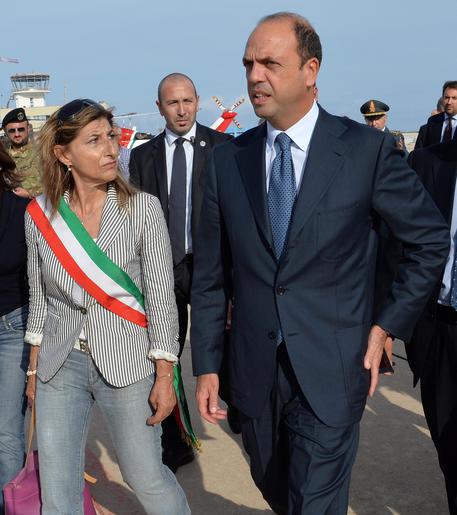
(ANSA) - Rome, April 11 - The European Union must take more responsibility for defending its southern sea borders rather than leave all of the work to Italy, Interior Minister Angelino Alfano said Friday. He spoke the same day that the United Nations High Commissioner for Refugees (UNHCR) said that the Italian navy had rescued as many as 6,000 migrants attempting a dangerous sea crossing to Europe over the past four days, and should have more assistance from the rest of the EU.

Alfano said that EU treaties have lowered borders among member states, but it still has a southern boundary to defend in the area of Italy's island of Lampedusa, where tens of thousands of migrants first make landfall. "The sea in front of Lampedusa is not an Italian border but the European Union (border) and Europe must assume the burden of defending it," said Alfano.

A spokeswoman for the UNHCR said earlier that the Mediterranean is one of the busiest seas in the world, and poses a "dangerous border...for many asylum seekers who seek salvation in Europe". She urged European Union members to work together on solutions to the migrant situation, which is expected to worsen, including improving legal channels for immigrants to Europe. Practical refugee aid, including additional shelters, is also needed, she added.