Translate

mercoledì 23 aprile 2014

Renzi Declassifies “Years of Lead” Files

"A duty to victims”, says PM. Order accelerates transfer of classified documents held by central government administrations


Following last week’s announcement, Italy’s prime minister, Matteo Renzi, yesterday signed an order declassifying files on the Ustica (1980), Peteano (1972), Italicus (1974), Piazza Fontana (1969), Piazza della Loggia (1974), Gioia Tauro (1970), Bologna railway station (1980) and Rapido 904 train (1984) murders. The signing took place at Palazzo Chigi in the presence of the junior minister for the Prime Minister’s Office with responsibility for the security services, Marco Minniti, and the director of the department of security information (DIS), ambassador Giampiero Massolo. Mr Renzi commented: “One of the key features of this government’s actions is transparency and openness. Today’s decision is a step in that direction. I consider it a duty towards Italians and towards the relatives of the victims of these events, which remain a dark stain on our collective memory”.


Later, Mr Renzi tweeted that the government had declassified documents on “some of the darkest pages in Italian history”, adding to the list the 1973 attack on the police headquarters in Milan. In line with last Friday’s ruling by the interministerial consultative and decision-making committee on intelligence service policy (CISR), the order enables early transfer of “classified files held by all central government administrations that represent an important contribution to the historic memory of the nation”.


The documents will be transferred in chronological order, from the oldest to the most recent, sidestepping the minimum legal limit of forty years in place for all files at central government administrations before they can be assigned to the state archive.

Academic speaks out against 'Italianglo' - the use of English words in Italian language

Annamaria Testa says her compatriots should stop using words like 'flop', 'fashion' and 'baby' when there are better Italian alternatives


Not many Italians speak good English. But nearly all of them are fluent in “Italianglo” – the random insertion of English words into their sentences. And it’s about time someone put a stop to it, a leading Italian academic has claimed.

With the weekend approaching, Italians will declare they are in the mood for a “relax” at the local “wellness” (health spa). Less salubrious ones might sneak off to the local “sexy shop”, after they’ve done “lo shopping” with their wives. The academic, Annamaria Testa, has set out on her website a list of 300 English words that she says Italians ought to stop using willy-nilly.

Ms Testa’s motivation stems less from French-style language chauvinism than her objection to the lack of logic and accuracy, and also the ugliness, with which “meeting”, “flop”, “location”, “sexy” and “stop”, are used – when there are good or better Italian alternatives. This is not a crusade against English,” she said. “To speak English or any other language well, in addition to speaking Italian, is a useful and wonderful thing. But it is not always necessary.”

She conceded that certain words were so well known, Old English-specific or without close Italian equivalents, as to merit frequent use in Italian, with “sport”, “rock”, “browser” and “smog” as examples. But the constant use of “flop”, “fashion” and “baby” – the last in phrases from “baby gang” for juvenile delinquents to “baby squillo” for underage prostitutes – made no sense when equivalents existed in Italian. The Italian press is much to blame. Even the Corriere della Sera, traditionally Italy’s stately newspaper of record, is ever-more inclined to print the latest news on “le top” (top models) or evidence of uncivilised behaviour or violence in the “Far West” (read “Wild West”) in crime-ridden parts of Rome or Milan.

Last November, even the ex-premier Silvio Berlusconi had a go when he launched into a long declaration of innocence when his tax-fraud conviction (for which he is about to serve community service) was confirmed by the Supreme Court. He used the English for “United States” and “finance” and constantly referred to “Mr Gordon” and “Mr Chan”, prompting a chorus of derision on Twitter.

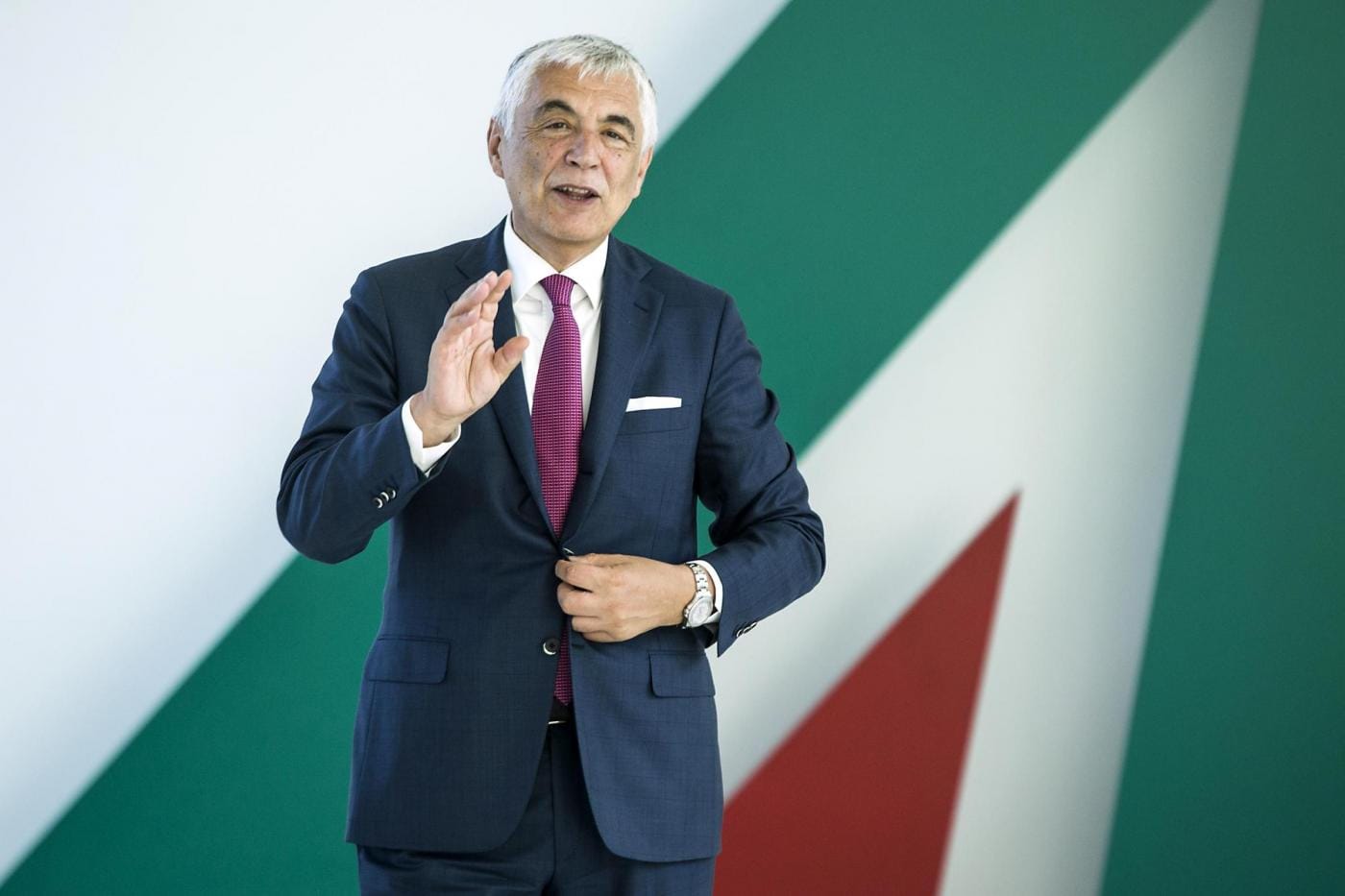
Del Torchio meets unions on Alitalia investment talks

Lupi dismisses reports of 3,000 airline job cuts


(ANSA) - Rome, April 23 - Gabriele Del Torchio, chief executive officer of troubled airline Alitalia,met with labour leaders to update unions on the status of a possible investment by Middle Eastern carrier Etihad, sources said Wednesday.

Del Torchio met with the leadership of trade confederations CGIL, CISL and the UIL after sessions Tuesday with Alitalia's board of directors about the deal, which would see Abu Dhabi-based Etihad invest about 500 million euros in cash-starved Alitalia, including a 300-million euros capital injection, in exchange for a 40% stake. The deal has been in the works for months which indicates the ongoing "skirmishes" on the road to reaching a deal, said Raffaele Bonanni, general secretary of the CSIL. Bonanni brushed off questions about possible layoffs and said talks are now focused on increasing intercontinental routes for Alitalia "to make a company that will really compete".

Transport Minister Maurizio Lupi also dismissed reports that a possible 3,000 layoffs at Alitalia have been demanded by Etihad as part of the deal. "I've never heard about 3,000 cuts," Lupi said Wednesday. Meanwhile, Premier Matteo Renzi said on his Twitter feed that a deal was still in play. "We anticipate a proposal from Etihad, then we will act accordingly," wrote Renzi.

Last week, Lupi revealed that Etihad had set further conditions on its possible investment in Alitalia, which has been anticipated for months but has stumbled over the amount of debt that Alitalia has on its books - about 800 million euros - as well as the size of the Italian carrier's workforce. Further clouding the deal have been complaints from competitors that could trigger European Commission concerns about ownership and control of European airlines as well as competition issues. The Gulf-based carrier has been drawn to Alitalia as it is vying to broaden its network in Europe. Etihad has been expanding aggressively into Europe, and Alitalia would give it a further foothold in a lucrative market. 

Chinese automakers 'knock off' Fiat 500L

Lifan 330 unveiled at motor show in Beijing


(ANSA) - Rome, April 23 - Chinese automakers are under fire for allegedly knocking off the larger deluxe version of Italy's celebrated Fiat 500. The Lifan 330, which debuted this week at the Auto China 2014 motor show in Beijing, bears a "striking" resemblance to the front end of the Fiat 500L, according to carnewschina.com, the only difference being in the width of the grills. Meanwhile the sides and tail resembled a Mini Cooper, enthusiasts say, recalling the 2003 Lifan 320, which varied from the British model only in the addition of two rear doors. The sticker price for the Lifan 330 starts at 4,226 euros, about four times cheaper than a no-frills Fiat 500L. 

Italian space researchers map sea on Saturn moon - update

Part of Cassini-Huygens mission


(ANSA) - Rome, April 23 - For the first time, a pair of Italian researchers have taken accurate measurements of the Ligeia Sea on the surface of Titan, which is the largest of Saturn's 63 moons. Marco Mastrogiuseppe and Valerio Poggiali, from Rome's La Sapienza University, are working with Cornell University and NASA's Jet Propulsion Laboratory (JPL) to map all the seabeds on Titan, whose surface is shaped by rivers and lakes of liquid ethane and methane (the main component of natural gas).

They work with data gathered by NASA's Cassini spacecraft and its European-built Huygens probe, which arrived in the Saturn system in 2004. "For the first time, we were able to directly measure the depth of an alien sea", Mastrogiuseppe told ANSA. "Ligeia is about the size of Italy's Adriatic Sea, it's about 200 meters deep, and contains 5,000 billion tons of hydrocarbons, mostly methane".

Titan is one of the most Earth-like worlds discovered to date, according to NASA. With its thick atmosphere and organic-rich chemistry, it resembles a frozen version of Earth from several billion years ago. Titan is of great interest to scientists because it has a substantial, active atmosphere and complex, Earth-like processes shaping its surface.

Mastrogiuseppe and Poggiali are now at work on mapping the biggest of Titan's bodies of water, the Kraken Sea, which the Cassini probe discovered in 2007. The Cassini-Huygens mission is a cooperative project of NASA, the European Space Agency and the Italian Space Agency. 

Govt to deploy 800 more mafia fighters in Calabria

To combat powerful 'Ndrangheta mafia


(ANSA) - Rome, April 23 - The government will deploy an extra 800 agents to fight the Calabria-based 'Ndrangheta mafia, State Police Chief Alessandro Pansa and Interior Minister Angelino Alfano said Wednesday.

The deployment comes under a national plan of action to fight crime in the southern Calabria region, where the 'Ndrangheta has become more powerful than the Naples-based Camorra and the Sicilian Cosa Nostra due to its stranglehold on the European cocaine trade. Of the extra law enforcers, 155 will be assigned to investigative teams and 355 will be on patrol. The remaining 290 are still to be assigned, Pansa said. 

Perugia makes short list for European Youth Capital 2017

Also bidding to be European Culture Capital 2019


(ANSA) - Rome, April 23 - Umbria's medieval capital Perugia on Wednesday made the short list of five contenders to become European Youth Capital (EYC) 2017. The city, famed for its shrines to St Francis of Assisi, university for foreigners, art and architecture, and food and wine, is up against Belgian capital Brussels, Cascais in Portugal, Galway in Ireland, Newcastle in the United Kingdom and Varna in Bulgaria. The Umbrian capital has also reached the final stage of the competition to become European Culture Capital 2019, to be announced by the end of the year.

The five EYC contestants - selected by an independent high-level jury - will now progress to the next round of competition to compete for the coveted title. During the second round, the cities will have an opportunity to present an extensive draft programme of youth-related cultural, social and political events and activities. As with previous competitions, the European Youth Capital 2017 will encourage the implementation of the Council of Europe's Charter on Local and Regional Participation of Young People through the promotion of new ideas and innovative projects. EYC initiatives lay the foundations for young people's active participation in society and present good practice examples to other European municipalities.

The five short-listed cities beat strong competition from Alcobendas (Spain), Kaunas (Lithuania), Vicenza (Italy) and York (United Kingdom) to advance to the second round. The top candidate cities will receive recommendations from the high-level independent jury and a youth focus group on how to make their applications even more responsive to young people. The winning city will be announced in November 2014 during an awarding ceremony in Cluj-Napoca, Romania (EYC 2015). In addition, the Congress of Local and Regional Authorities of the Council of Europe is now an endorsing partner of the European Youth Capital.

Peter Matjasic, President of the European Youth Forum, said: "This prestigious title is a fantastic way to showcase good practice examples of youth policy making and youth participation at local level and think of new, innovative ideas and projects designed by and for young people to truly engage them in the life of their city. "The EYC is also a unique way to strengthen the bonds between the candidate cities and Europe, while the winning city can serve as a springboard for more cross-border cooperation and manifestation of the European spirit the young generation of today embodies. "Good luck to all those shortlisted!"